Mobile phone radiation: how many more signals will we have to ignore?

Mobile Phones and Health: Silence Is No Longer an Option

We live surrounded by mobile phones, day and night, in our pockets, on our bedside tables, in our children's hands. Yet, a crucial question is too often avoided: what do we really know about the long-term effects of electromagnetic waves on our health?

Contrary to what we often hear, science does not conclude that there is no danger. It concludes that there is persistent uncertainty, accompanied by concerning biological signals. And in matters of public health, uncertainty is never neutral.

What the Studies Say (In Simple Terms)

Hundreds of scientific studies have analyzed the impact of the waves emitted by mobile phones.

Even if they don't all point in the same direction, several results are recurring:

  • The exposed body reacts with oxidative stress, a mechanism involved in many chronic diseases;

  • Some cells show disruptions in their normal function;

  • Effects are observed on sperm quality in several experimental studies;

  • Brain activity can be altered during prolonged exposure.

? In other words: living organisms react to electromagnetic waves, even at levels considered "safe".

Cancers: Why the Warning Still Exists

Mobile phone radiation is classified as "possibly carcinogenic" by the World Health Organization via the IARC. This classification is neither insignificant nor symbolic: it means that a credible risk has been identified, even though definitive proof has not yet been established.

Must we wait decades, as with asbestos or tobacco, before taking action?

The argument of a lack of certainty has already cost public health dearly.

Outdated safety standards?

Current regulatory limits are essentially based on a simple idea: as long as the waves do not heat tissues, they are considered harmless. However, modern research shows that:

  • biological effects exist without heating;

  • exposure is daily, cumulative, and long-term;

  • children, adolescents, and pregnant women are more vulnerable.

Can we reasonably claim that standards designed years ago are still sufficient today?

The precautionary principle: common sense, not fear

Asking for greater caution does not mean rejecting technology. It means protecting the population while science advances.

Simple actions can already significantly reduce exposure:

  • use headphones or the speakerphone;

  • avoid holding the phone against your body;

  • don't sleep with the phone near your head;

  • limit use by children.

These measures cost nothing.

Inaction, however, could prove very costly.

An additional concrete solution: anti-radiation cases

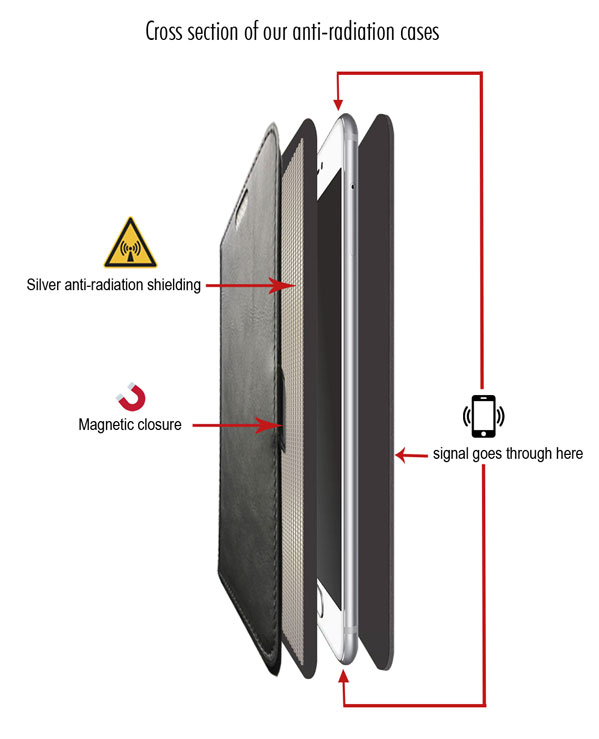
Beyond common-sense precautions, there are now additional protective solutions, such as anti-radiation cases for mobile phones. These cases are designed to reduce direct exposure of the head and body to electromagnetic waves, particularly during calls or when the phone is held against the body.

Without claiming to eliminate all emissions—which would be unrealistic—an anti-radiation case acts as a partial barrier, directing the waves away from the user and thus limiting absorption by the tissues. In the context of repeated and prolonged exposure, this reduction can represent a significant gain in precaution, particularly for heavy users, children, and sensitive individuals. Using a shielding case is a pragmatic way to apply the precautionary principle without giving up mobile technology.


Conclusion: Choose caution over denial

The electromagnetic waves of mobile phones are neither a fantasy nor an absolute certainty. They are a potential risk in a context of mass exposure.
Continuing to downplay the issue means prioritizing comfort and economic interests over public health.

The truly reasonable position today is not denial, but informed caution.

Scientific References (selection)

  1. A Systematic Review of the Impact of Electromagnetic Waves on Living Beings, Cureus, 2024–2025.

  2. Health and safety practices and policies concerning human exposure to RF/microwave radiation, Frontiers in Public Health, 2025.

  3. Epidemiological criteria for causation applied to human health harms from RF-EMF exposure: Bradford Hill revisited, Frontiers in Public Health, 2025.

  4. International Agency for Research on Cancer (IARC/WHO) – Radiofrequencies and cancer, Group 2B classification.

  5. ANSES – Exposure to electromagnetic fields: state of scientific knowledge, recent reports.

  6. National Toxicology Program (USA) – Radiofrequency Radiation Studies and Cancer Risk.

Comments (0)

No comments at this moment